Signs Your Pool Liner Is Failing, and What Replacement Involves
A liner rarely fails all at once, and the owners who catch the early signs get the calmer job.
October 20, 2026 · 4 min read
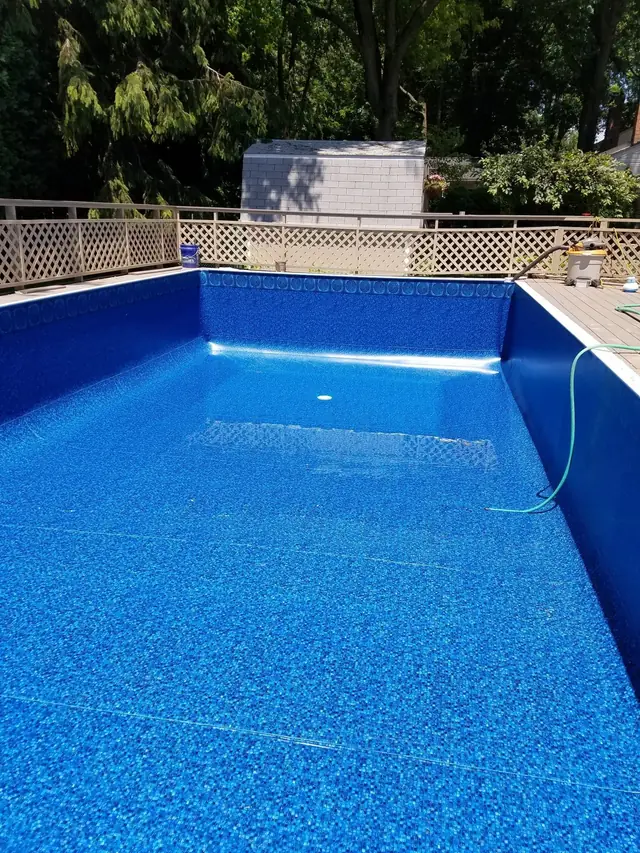
A vinyl liner is the part of an above-ground pool you look at every day, and it's also the part that wears out first. Sun, chemicals, foot traffic, ground movement and cold winters all take a little from it each year. Most liners don't fail all at once. They give you warnings, and the owners who catch them early usually have a simpler job on their hands than the ones who find out when the water level drops overnight.
Fading, brittleness and thin spots
Color fade is the first sign most people see, usually near the waterline and on the steps where sun and chemicals hit hardest. Fading alone doesn't mean the liner is leaking, but it does suggest the vinyl has been losing the softeners that keep it flexible. Press on an older liner along the wall. If it feels stiff, crinkly or chalky, it has lost some of its stretch, and stiff vinyl splits when it's asked to move, whether that's from cold weather or from the water pushing it into a corner.
Wrinkles and slack
A few small wrinkles after a fresh install usually settle out. New wrinkles on an older liner are different. They can mean the liner has stretched unevenly, the floor underneath has shifted, or the liner has slipped out of position at the wall. Deep folds on the floor trap dirt and wear faster because they catch every foot and every pass of the vacuum. If you can't smooth a wrinkle out and it keeps coming back, the liner no longer fits the pool the way it did.
Tears, pinholes and water loss
Obvious tears are easy. The sneaky ones are pinholes and seam failures, which show up as a slowly dropping water line. Before you blame the liner, run a simple check. Set a bucket of pool water on a step with its level matched to the pool's, and compare the two after a day or so. If the pool drops further than the bucket, you're losing water to something other than evaporation. The leak could be the liner, but it could just as easily be a fitting, the skimmer or return, or a plumbing line. Finding the real source first keeps you from replacing a liner that wasn't the problem.
A liner pulling out of the track
Most above-ground liners hang from a bead that locks into a track along the top of the wall. When the bead pops loose, the liner slides down, the water drags it away from the wall, and you can end up with a floor full of folds and a wall edge exposed to the water. Sometimes this is a one-time slip that gets reseated. If it keeps happening, the liner may have shrunk, the track may be damaged, or the wall behind it may be out of shape. That's worth a look before the next fill.
What replacement involves
Swapping a liner is more than unrolling a new one. A careful job goes in sequence:
- Drain the pool and pull the old liner out of the track
- Look over the wall and bottom track for rust, dents and sharp edges, because anything sharp will cut the new liner
- Repair or smooth the floor and cove so the new liner sits on a clean, even surface
- Set the new liner into the track and square it to the pool
- Draw out trapped air so the vinyl lies flat against the floor and wall
- Start the fill, adjusting the liner as the water comes up so the wrinkles come out before the weight locks them in
That prep matters more than people expect. A new liner laid over a rough floor or a rusting wall won't last, because the problems underneath wear through it from the other side. If the wall needs work, it's far easier to find out with the old liner out of the way. Bob Clement Pool Service handles liner replacement for above-ground pools as well as wall replacement, so one visit can tell you whether you need one or both.
Liner or tile
Some owners ask whether they should skip vinyl altogether. Pool liners are a great and affordable alternative to traditional tile, and a well-kept one can look very close to the real thing. The trade is that a liner is a surface you'll replace someday, where tile is a surface you maintain. For the above-ground and wood pools that most homeowners around Clinton Township have, a liner is what the structure is built around.
Fix the cause, not just the symptom
A liner that fails early is often telling you about something else: a wall edge that's rough, a floor that's uneven, water chemistry that has been running hard, or a pool that moves more than it should. Replace the liner without dealing with that, and the new one inherits the same fate. Ask whoever gives you an estimate what they found underneath the old liner, not just what they plan to put on top.
If your liner is fading, wrinkling or losing water, call Bob Clement Pool Service at (586) 463-2090 for a free estimate on liner repair and replacement. The goal is a job done right the first time, so you aren't calling back about the same pool.
Bob Clement Pool Service LLC, (586) 463-2090
Call (586) 463-2090More articles
Repair or Replace: When an Above-Ground Pool Wall Is Past Saving
Most wall trouble starts small, and a few checks you can make yourself will tell you which side of the line your pool is on.
Owning an Older Wood Pool in Michigan: Restore It or Replace It
A wood pool lives or dies by its frame, and the frame lives or dies by how well it dries out.